
Build your own arcade
Arcade Cabinet Dimensions: Room and Doorway Checker
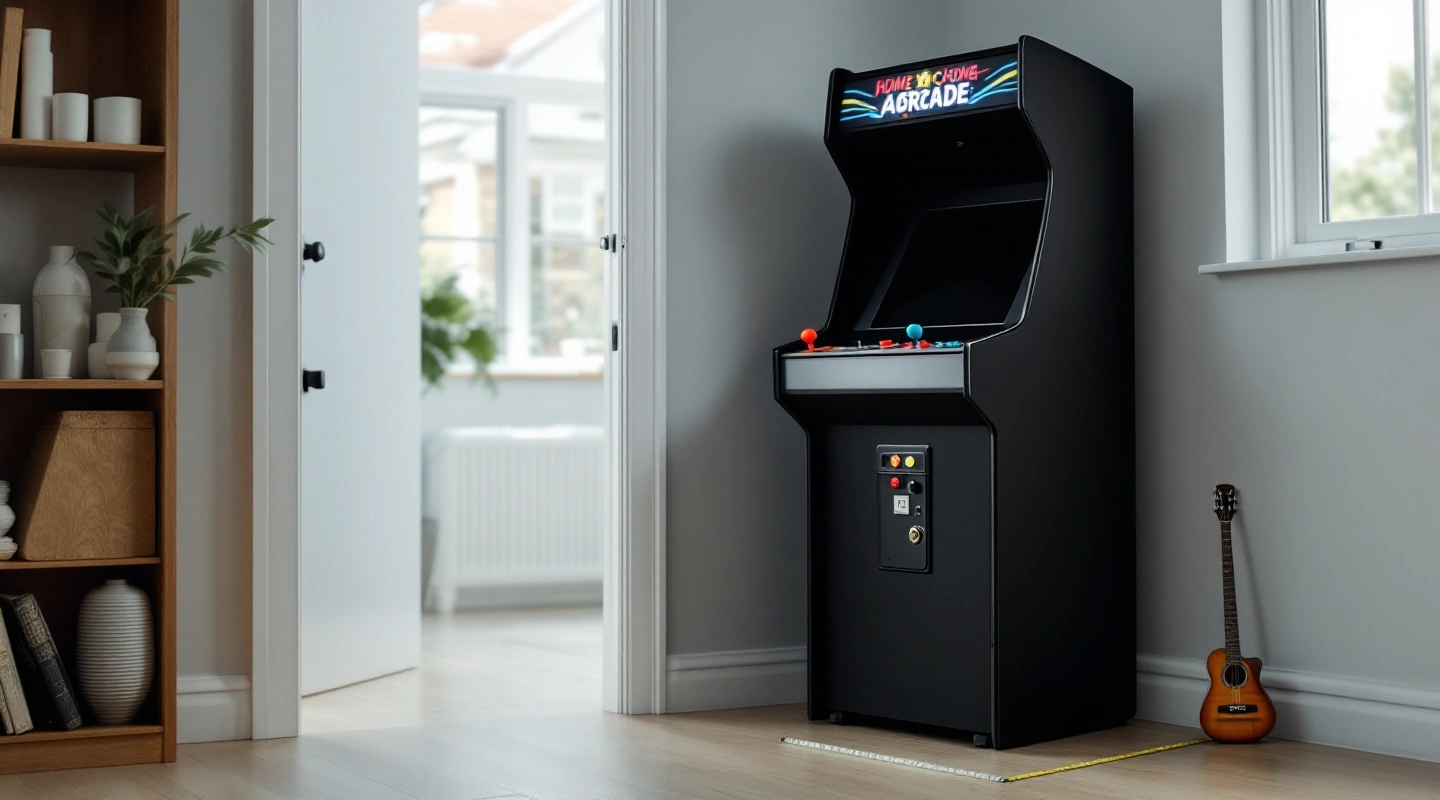
Check a cabinet against a room and doorway
Model measurements come from the records below. Room, doorway and clearance defaults are a hypothetical example. Replace them with your measurements.
Print calibration: the line below must measure 100 mm at actual size.
Model measurements and manual worksheet
Arcade1Up Ms. Pac-Man & Galaga Class of '81 Deluxe
- Assembled W × D × H
- 18.82 × 22.44 × 61 inches
- Assembled weight
- 68 lb; not a floor-load approval
- Transport record
- Unknown; no disassembly dimensions inferred.
- Model reference
- Arcade1Up exact edition page
Maker labels L × W × H; L is treated as front-to-back depth. Assembled only. Confirm the order against your carton/manual before a tight fit.
Arcade1Up Mortal Kombat II Countercade, 7-inch edition
- Assembled W × D × H
- 9.45 × 8.74 × 13.19 inches
- Assembled weight
- 6.6 lb; not a floor-load approval
- Transport record
- Unknown; no disassembly dimensions inferred.
- Model reference
- Arcade1Up 7-inch Countercade page
Maker L × W × H normalized as depth × width × height. Countertop support height and strength are separate.
Raw Thrills Big Buck Hunter Reloaded Mini
- Assembled W × D × H
- 42 × 31 × 91 inches
- Assembled weight
- 428 lb; not a floor-load approval
- Transport record
- 43 × 37 × 83 inches, W × D × H. Main cabinet pallet only; separate equipment and handling are outside this screen.
- Model reference
- Raw Thrills Reloaded Mini location specifications
Commercial cabinet, not Arcade1Up. Location dimensions only; playing distance is additional. Do not mix the Mini, Panorama or older manual dimensions.
Manual worksheet: required room width = cabinet width + left + right allowance. Required room depth = cabinet depth + front + rear allowance. Spare room height = room height − cabinet height. For a 90-degree orientation exchange width and depth. Doorway screen compares selected-state width and height plus twice the handling margin to measured clear opening. A straight approach must have at least the selected-state depth plus twice the margin. A blank route field means unknown. Vehicle checks compare each selected-state bounding dimension with the opening and usable cargo box, not cargo volume. No turning, stair, tilt, payload or lifting approval.
A pass covers the entered straight-clearance measurements only. Plan corners, stairs and handling from the exact model instructions. Check the rated floor support and vehicle payload separately.
Compare home cabinet optionsOn this page7
Arcade cabinet dimensions describe the cabinet, not the whole space needed to play it or move it into a room. A listing may show assembled size, a shipping carton or a control panel. Select the right record before comparing any of those numbers with a doorway.
Measure the room and the narrowest clear door opening. Choose the exact model below and add your own player and service gaps. The room result uses the assembled cabinet. Door and cargo-style checks use only the chosen sourced state. A pass covers entered straight clearances; it says nothing about stairs or corners, nor tilting or safe handling.
Compare arcade cabinet dimensions by model and state
The tool keeps three maker records. One is the small Mortal Kombat II 7-inch Countercade. The others are Class of '81 Deluxe and Big Buck Hunter Reloaded Mini. They span a wide range of sizes. Use them as size examples, not a ranked shopping list.
The Class of '81 maker page labels its dimensions L × W × H. The tool uses the published length as front-to-back depth and keeps that assumption visible. Confirm the dimension order against the exact carton or manual when clearance is close. No shipping size is inferred from the assembled cabinet.
Raw Thrills lists Reloaded Mini apart from its Panorama versions. Do not swap their figures. The pallet has its own size record too. That record does not tell you how to take the machine apart. It covers only the state named by the maker.
Measure the room rather than the empty corner
Use clear usable width and depth. A baseboard or a radiator, or a low shelf may occupy part of an apparently open corner. Check height at the point where the cabinet will stand. Add the room's normal furniture and walking route before deciding what space is free.
The front gap is your chosen room space budget for a player, not a manufacturer safety distance. The rear gap is your chosen access and service space. Use the actual maker instructions if they require more. The starting values are a worked example so the tool can show its arithmetic; they are not measurements of your home.
For a tabletop cabinet, the room footprint alone is incomplete. Include the supporting table, its usable top and its height. The small Countercade record cannot approve a shelf's strength. For a gun game, cabinet depth does not include every possible stance or aiming distance. Check those needs in the exact game manual.
Calculate a footprint with room to use it
The width calculation adds the left and right gaps to the cabinet width. The depth calculation adds the front and rear gaps to the cabinet depth. The tool subtracts those totals from the measured room to show remaining space. Negative remaining space means the entered space budget does not fit.
For example, a hypothetical 60 cm-wide cabinet with 15 cm on either side needs 90 cm of room width. That is an arithmetic example, not a record for a named machine. If the available width is 85 cm, the space budget is short by 5 cm even though the cabinet alone would fit.
The chosen orientation exchanges width and depth for a side-first arrangement. It does not search for a diagonal solution. Player and rear gaps stay attached to the displayed room axes, so adjust those entries to describe how the cabinet will actually face in the room.
Check arcade cabinet dimensions against a doorway
Measure clear width with the door in its practical open position. Use the narrowest opening, not the width printed on a door label. Measure clear height beneath trim and overhead obstacles. A cabinet's weight does not change that geometry, but it changes the handling problem that this tool does not solve.
Choose assembled upright or a sourced transport record. If the chosen model has no transport record, the tool says unknown. It does not subtract a riser or remove a control panel based on a photo. Enter manual measurements only when you know what physical state they describe.
The handling margin is added on both sides of width and height. That makes the distinction between an exact geometric equality and a chosen clearance visible. The straight-approach field checks the chosen footprint depth as well. Leaving it blank keeps the overall approach result unknown even if the door opening itself is wide enough.
Read the result's limits
A room pass and a doorway pass answer different questions. You can have enough floor space but no straight route through the door. You can also pass an opening check and have no room to stand comfortably at the controls. Keep both results with the model and state when printing.
This checker does not approve turning in a hall or moving a cabinet up stairs. It does not calculate a tilt angle, floor loading or lifting method. A commercial cabinet weight is a sourced description, not evidence that a particular floor or vehicle is suitable.
If a check fails, first confirm the units and chosen edition. Then look for a smaller format or revise the room layout. Do not erase the handling gap just to turn a failure into a pass. If a route measurement is unknown, measure it before making a delivery commitment.
Frequently asked questions
Is a full-size cabinet a standard size?
No. Full-size is a format description used across different makers and editions. A narrow home upright and a commercial gun cabinet can differ greatly in every measurement. Use the exact model record, then check the source's dimension order and whether it describes the assembled machine or a shipping state.
Does the tool allow for a riser?
Only when the chosen source record includes one in its assembled dimensions. It does not add or remove a generic riser height. If your exact cabinet is measured in a different setup, use manual measurements and label that state. Do not reuse another cabinet's riser or transport figures.
Why is the doorway result unknown?
A required measurement or the chosen transport record is missing. Blank does not mean zero and it does not mean a pass. Enter the clear width and height, then confirm a straight approach. A maker's assembled measurements cannot establish an undocumented folded or partially disassembled transport state.
Are centimeters and inches calculated differently?
No. The tool normalizes dimensions to centimeters using 2.54 centimeters per inch. Changing units converts the entered measurements rather than resetting the room. Small displayed rounding can appear, but the calculation keeps more precision. Recheck the displayed units before copying a measurement to a paper worksheet.
Verdict
Keep arcade cabinet dimensions with the exact model and state. Check the source too. Use the result for a straight route and room fit. Keep the unknowns on your sheet. Next, use the cabinet build guide or the full-height guide to plan the rest of the room.