
Home arcade cabinets
Arcade Machine Full Size: Height, Footprint and Doorways
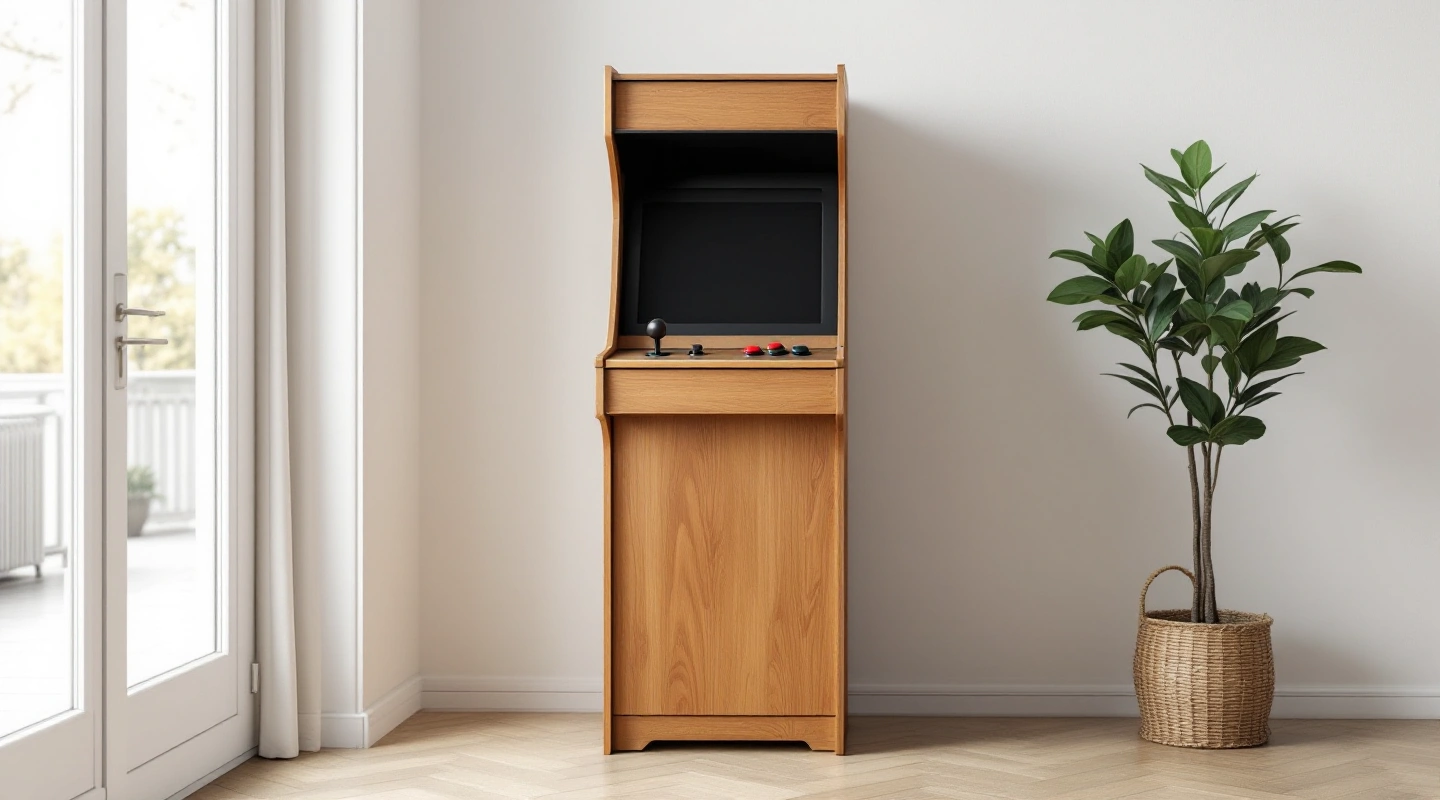
Check a cabinet against a room and doorway
Model measurements come from the records below. Room, doorway and clearance defaults are a hypothetical example. Replace them with your measurements.
Print calibration: the line below must measure 100 mm at actual size.
Model measurements and manual worksheet
Arcade1Up Ms. Pac-Man & Galaga Class of '81 Deluxe
- Assembled W × D × H
- 18.82 × 22.44 × 61 inches
- Assembled weight
- 68 lb; not a floor-load approval
- Transport record
- Unknown; no disassembly dimensions inferred.
- Model reference
- Arcade1Up exact edition page
Maker labels L × W × H; L is treated as front-to-back depth. Assembled only. Confirm the order against your carton/manual before a tight fit.
Arcade1Up Mortal Kombat II Countercade, 7-inch edition
- Assembled W × D × H
- 9.45 × 8.74 × 13.19 inches
- Assembled weight
- 6.6 lb; not a floor-load approval
- Transport record
- Unknown; no disassembly dimensions inferred.
- Model reference
- Arcade1Up 7-inch Countercade page
Maker L × W × H normalized as depth × width × height. Countertop support height and strength are separate.
Raw Thrills Big Buck Hunter Reloaded Mini
- Assembled W × D × H
- 42 × 31 × 91 inches
- Assembled weight
- 428 lb; not a floor-load approval
- Transport record
- 43 × 37 × 83 inches, W × D × H. Main cabinet pallet only; separate equipment and handling are outside this screen.
- Model reference
- Raw Thrills Reloaded Mini location specifications
Commercial cabinet, not Arcade1Up. Location dimensions only; playing distance is additional. Do not mix the Mini, Panorama or older manual dimensions.
Manual worksheet: required room width = cabinet width + left + right allowance. Required room depth = cabinet depth + front + rear allowance. Spare room height = room height − cabinet height. For a 90-degree orientation exchange width and depth. Doorway screen compares selected-state width and height plus twice the handling margin to measured clear opening. A straight approach must have at least the selected-state depth plus twice the margin. A blank route field means unknown. Vehicle checks compare each selected-state bounding dimension with the opening and usable cargo box, not cargo volume. No turning, stair, tilt, payload or lifting approval.
A pass covers the entered straight-clearance measurements only. Plan corners, stairs and handling from the exact model instructions. Check the rated floor support and vehicle payload separately.
Compare home cabinet optionsOn this page8
“Arcade machine full size” is a broad search label. It can describe a home cabinet tall enough for standing play, a shorter cabinet on a riser or a much larger commercial machine. Start with an exact edition and its dimensions. The label alone cannot tell you how it will fit or feel in your room.
Choose a cabinet by its assembled measurements and chosen player position. A full-height home upright can be narrower than commercial hardware, while a riser changes height without making the control panel wider. Use the fit checker for the room and a straight doorway. Test control height separately, and leave unmeasured corners or transport states unresolved.
What full size means on an arcade machine
There is no single size shared by the cabinets discussed here. Makers use format names to describe their products, but the usable answer is a measurement record. Keep the maker, edition and physical state together. A product photo taken from below is not a reliable height comparison.
The Class of '81 Deluxe page describes a home upright over five feet tall. It has a single shell. The Reloaded Mini page describes a much taller commercial gun game. Both stand on the floor. Their room and route needs are far apart.
The tool includes the small 7-inch Countercade as a scale contrast. It is not a full-height machine. A smaller screen or familiar game name must not be mistaken for a full-size cabinet listing.
Compare full-height and riser arrangements
A riser is a separate base used by some home cabinets. Whether it is included depends on the exact model and bundle. Do not add a generic riser height to a published assembled figure. That figure may already include the base, or the cabinet may have no separate riser at all.
For a used listing, ask for the full built height. Ask for photos of the base joint too. Keep the model label with that record. The words “with stand” do not prove it is the correct base. Check the actual part and its fixings.
Cabinet height and control height are also different. Two cabinets with similar top heights can put the buttons at different levels. A taller marquee does not raise the controls. Mark the chosen control surface on a wall and test a cardboard panel before deciding that a number on a listing fits your stance.
For seated play, add the actual seat height and knee position to the trial. Do not use a stool simply to correct an otherwise unsuitable panel. The useful test is whether the chosen player can reach the controls and see the whole image without an awkward posture.
Measure the occupied floor area
The bare footprint is width times depth. Add room for the people at the controls. Add the access you need around the unit too. For two players, check both bodies and elbows at once. A narrow floor rectangle can hide a crowded control area.
Use removable tape to mark the cabinet and gaps on the floor. Open nearby doors and drawers. Walk the room's normal route. Add any seat in its pulled-out position rather than tucked neatly under a table. This makes the room trial more useful than a single total square-foot figure.
Service access is a separate gap. Check which panels must open to reach the computer or display. A cabinet that fits tightly between two walls can be difficult to maintain. The tool's rear and side defaults are editable planning examples, not universal installation distances.
For a gun cabinet, use the exact maker's play-space requirements in addition to its published cabinet depth. The tool does not calculate aim tracking or ideal shooting distance. Compare the home and commercial Big Buck formats before treating a compact gun cabinet as an ordinary upright.
Check an arcade machine full size route
Measure the narrowest clear width and height on the straight doorway segment. Include door hardware and overhead trim. The tool adds the handling margin you enter on both sides. A measurement that equals the opening exactly has no extra margin simply because the screen says it is a geometric match.
Choose the state that will actually pass through that opening. A sourced shipping pallet is not the assembled cabinet. A boxed dimension is not permission to fold a backbox or remove a control panel. If the maker has not supplied that state, keep it unknown or measure the exact physical item.
The orientation selector checks front-first or side-first upright dimensions. It does not tilt the cabinet or calculate a diagonal turn. A hall with a corner needs more than an opening rectangle. Stairs and landings also remain outside the tool's scope.
Record who is responsible for delivery beyond the curb. A seller can offer shipping without offering room placement. Confirm the destination and service level before ordering. A successful doorway calculation does not create an agreement to bring a heavy machine through it.
Compare controls and screen before choosing scale
Full height is useful only if the cabinet suits the chosen play. Check player count and the input types for the actual games. A single lever and button group cannot reproduce every control arrangement. A cabinet with a large game list can still be a poor match for a favorite title.
Check the image area from the player position. A portrait game on a landscape screen may leave unused space. The monitor guide explains why diagonal size is not the same as the useful picture. Keep viewing angle and bezel coverage in the trial.
For a DIY cabinet, the button layout worksheet checks hole centers and mounting envelopes. Use a real mockup to check reach. For a prebuilt cabinet, read the exact maker's layout and edition information rather than assuming parts can be swapped without affecting fit or warranty.
Read a pass without over-reading it
The checker gives two results: room fit and doorway fit. It keeps the model and units in view. Missing approach size or transport data stays unknown. That tells you what to measure next. It does not invent a delivery verdict.
If room space budget fails, compare the footprint with the player gaps. If the door fails, check the chosen state and dimension order. Do not reduce the margin merely to get a pass. A compact format, another room or a different sourced route may be the better decision.
The machine's weight is a separate sourced fact. The checker does not approve floor strength, vehicle payload or a lifting method. Keep the actual source record and any delivery agreement with your measurement sheet. They answer questions that width and height cannot.
Frequently asked questions
Is a home full-size cabinet the same as an original arcade machine?
Not necessarily. A home maker can use full-size to describe standing height while using a narrower shell or different display. Compare exact measurements and controls rather than the label. A licensed home version also does not become identical to the original commercial hardware because it carries the same game name.
Can I take a riser off to fit a doorway?
Only use a transport state sourced for the exact cabinet or measured for the actual item. The tool does not subtract a standard riser height. Removing a part can change handling and fastening needs. A source's assembled measurement does not establish the dimensions or safety of a different setup.
Does room area tell me enough?
No. A room can have enough total area but the wrong usable width, a low ceiling point or a blocked walking route. Check each dimension at the proposed position. Add the player's space and needed access. Then assess the route to the room as a separate task.
What if the manufacturer gives length instead of depth?
Keep the original labels beside your normalized record. For a cabinet, confirm which direction the maker calls length before treating it as front-to-back depth. The tool exposes that assumption for the relevant records. If the fit is close, verify it against the exact manual or physical measurement.
Verdict
An arcade machine full size decision starts with the exact cabinet, then the player and route. Use the checker to keep those measurements visible. For a custom enclosure, continue to the DIY build guide; for the broader format choice, return to home arcade machines.