
Tabletop pinball
Tabletop Pinball: Small Physical Ball Machines
On this page10
- Separate tabletop pinball from a digital screen
- Read the controls, not just the product name
- Check the whole desktop footprint
- Account for kit assembly and power
- Check scoring and play limits
- Use the maker's age and part guidance
- A tabletop pinball decision sheet
- Compare a kit with a ready-built toy
- Frequently asked questions
- Verdict
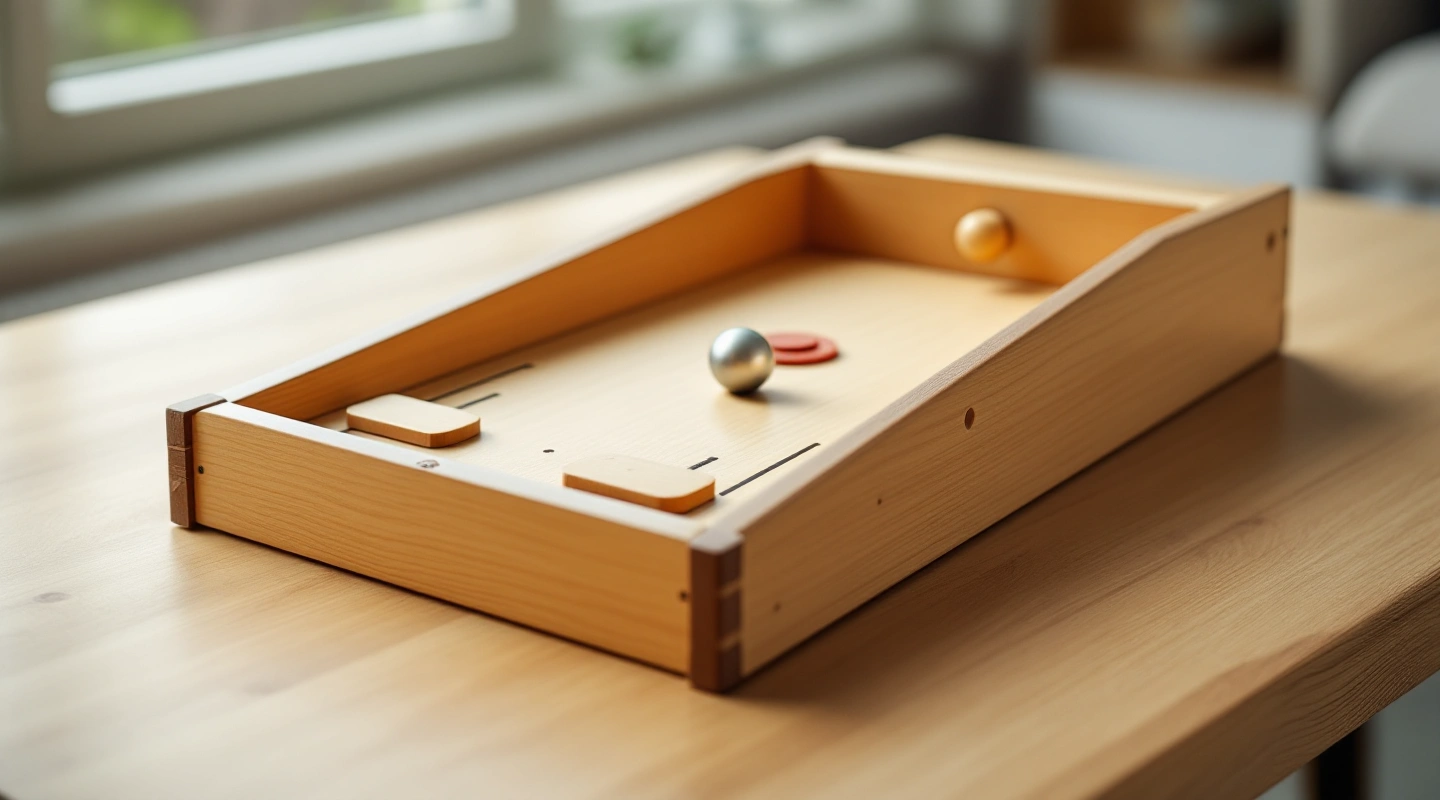
Tabletop pinball covers more than one kind of small game. Some units have a real ball and flippers. Others are spring-launch target toys with no active flipper control. A digital tabletop cabinet can use a screen instead of a physical ball. Identify the mechanism before choosing by size or theme.
Choose a physical tabletop game by its ball and flipper arrangement, then check the complete size on your actual table. A kit also needs assembly and its specified power source. A simple target toy may have a launcher without full pinball controls. Keep those differences visible; a compact digital cabinet does not become a physical ball machine because its buttons resemble pinball buttons.
Separate tabletop pinball from a digital screen
A physical game moves a real ball through the play area. A digital table shows a simulated ball on a screen. These are different forms of play. Check the maker's description and a clear view of the surface. Make sure it is the form you want.
AtGames' Legends Pinball HD page describes LCD playfield and backglass displays. That is a digital-cabinet reference, not an example of a small physical flipper game. Keep screen-based products out of a physical tabletop comparison unless the distinction is explicit.
A small toy also does not reproduce the whole feel of a full-height mechanical machine. Ball size and travel differ, as do the controls and playfield features. This guide does not rate those differences from hands-on testing. It helps identify what the maker actually supplies.
Read the controls, not just the product name
Look for a launcher, flippers and any active scoring mechanism as separate fields. A launcher can send a ball toward fixed targets without giving you flippers to keep it in play. If you want flipper control, confirm that it is part of the exact product rather than assuming it from the word pinball.
Schylling's Space Race Pinball page describes a handheld spring-launch target toy. It is useful for understanding that simpler format. Its page showed out of stock. It should not be represented as a full flipper machine or a currently available retail pick.
Robotime's ROKR 3D Pinball EG01 page describes a build-it-yourself physical pinball kit. The maker has a matching assembly and fault-help route. A kit's construction task is part of the choice, not a hidden extra after purchase.
These are source examples of different mechanisms. They are not a ranked shopping list, and no firsthand play score is assigned. Compare the exact control behavior you want before looking at decorative lights or the advertised theme.
Check the whole desktop footprint
Use complete assembled dimensions. Include any protruding launcher or control that needs hand access. Put a paper outline on the actual supporting table. Then place your hands where they need to be during play. The support surface must accommodate the game and its use, not just the box stored at rest.
Robotime lists the EG01 assembled size as 27.5 × 47.5 × 28 cm. Keep the maker's order with the record and confirm which axis matters for your table. The assembly reference repeats those dimensions. They describe that exact kit, not every wooden tabletop game.
The Space Race page has a broad height description and a separate specification box. The spec box gives 0.75 × 5.5 × 11 inches, while its prose uses a shorter broad height phrase. Keep that inconsistency visible and confirm the actual item when storage space is tight. Do not silently blend the two figures.
Leave access to both sides if the controls are there. Check cables behind a powered game and keep the normal walking route clear. A compact base does not mean it can sit at the very edge of a shelf during play. The furniture's strength and stability need their own check.
Account for kit assembly and power
A wooden kit can be a construction activity as much as a game. Read the maker's instructions before deciding whether that is the task you want. Check required consumables and tools. A stated build time is a maker estimate, not a completion promise for your experience level.
Keep the exact EG01 assembly route with the model code. Use it for part identity and troubleshooting. Do not borrow power or wiring instructions from a different kit with similar-looking lights.
For any powered tabletop machine, record the specified power input and what is included. If the listing does not settle batteries or an adapter, mark that field unknown. A USB-shaped connector does not by itself establish the required supply. Use the supplied instructions and leave electrical modifications outside this task.
Check scoring and play limits
Ask how the score is kept. A simple target toy may use printed targets or pockets. Another game can use sensors or electronic scoring. Read what is actually measured; a bright score display does not make the rest of the playfield equivalent to a full-size machine.
Look at how a ball is returned and whether spare balls or parts have a sourced route. Keep the playing surface level as the maker directs. Do not add a guessed slope to change difficulty. An adjustment that changes the game can also affect mechanisms or the ability to retain a ball.
Noise and play feel are not rated here. Maker descriptions can explain construction, but they do not prove how loud a unit will sound on your furniture. If those details matter, seek a demonstration of the exact product. Do not present another owner's comments as this publication's own testing.
Use the maker's age and part guidance
This guide addresses adult buyers. Read the exact age guidance and small-parts warnings before choosing an item for a household. The Schylling page carries small-parts cautions. Do not infer that all compact pinball games suit the same ages from a toy's size or colorful appearance.
For a kit, distinguish the assembly guidance from guidance about playing the completed item. Small pieces and tools can make those separate tasks. Retain the maker's instructions with the finished game. This publication collects no children's information or play records.
A tabletop pinball decision sheet
Write these facts for each exact candidate:
- Mechanism: real ball or simulated display; launcher and flipper functions.
- Complete size: maker's axis order and any projecting controls.
- Support: usable table area and the chosen hand position.
- Assembly: complete unit or kit, with the matching instruction route.
- Power: exact specified supply, batteries and included accessories.
- Scoring: how the game records or displays results.
- Parts: sourced source for missing or replacement items.
- Household fit: exact maker age guidance and small-parts cautions.
Unknown fields stay unknown. If the product page never confirms a feature, do not add it because a similar game has it. Keep the source date beside the record and reopen the page before a purchase. The pinball cost guide explains why format must stay beside a price.
Compare a kit with a ready-built toy
A kit needs a clear workspace before it needs a place to play. Read the first assembly pages and identify the small parts and tools. Keep pieces sorted by the maker's identifiers. A tray can make it easier to find a part without placing loose pieces near the edge of the table.
Check the route for a missing or damaged part before you begin. Keep the model code and the instruction revision with your request. A photo of the part location can help explain the issue, but do not substitute a visually similar piece from another kit without the maker's guidance.
A ready-built target toy removes that assembly task, but it also offers a different control system. Decide whether the interest is the build, flipper play or a simple portable target game. Those are three separate reasons to choose a tabletop item. Use the actual mechanism rather than the most elaborate product photo to make that choice. Keep the playing surface clear after each session too.
Frequently asked questions
Is every tabletop pinball game a flipper game?
No. Some small products use a spring launcher and fixed targets without active flippers. Check the exact mechanism in the maker's description. If you want the ability to keep the ball in play with side controls, confirm those controls rather than relying on the broad product name or theme.
Is a digital tabletop cabinet physical pinball?
It can have real buttons and a plunger, but its ball may be simulated on a screen. Keep that distinction explicit. A display-based cabinet offers a different mechanism from a real ball moving over a physical surface. Choose the form of play before comparing cabinet size or table count.
Does a wooden kit come ready to play?
Not when it is sold as an assembly kit. Read the matching instructions and check the required power and consumables. A maker's time estimate does not promise how long your build will take. Keep the construction task and the completed game's play features as separate parts of the decision.
Can I store the game on any shelf?
Check the full size and any projecting controls against the usable shelf area. Storage and play are different states; hands and cables need space during use. The maker's dimensions do not approve a shelf's load or stability. Use the actual furniture and instructions rather than a generic tabletop label.
Verdict
Choose tabletop pinball by the mechanism first. Confirm the ball and flipper functions, then the table space and exact assembly needs. Return to home arcade formats for the wider room choice, or use the pinball size guide if you are moving toward a larger cabinet.